When Thoughts Feel Like Facts
If you live with social anxiety, you know how convincing your mind can be. One critical thought can hijack your whole day. Sometimes it’s not even words, just a feeling, like a mood or tension in your body.
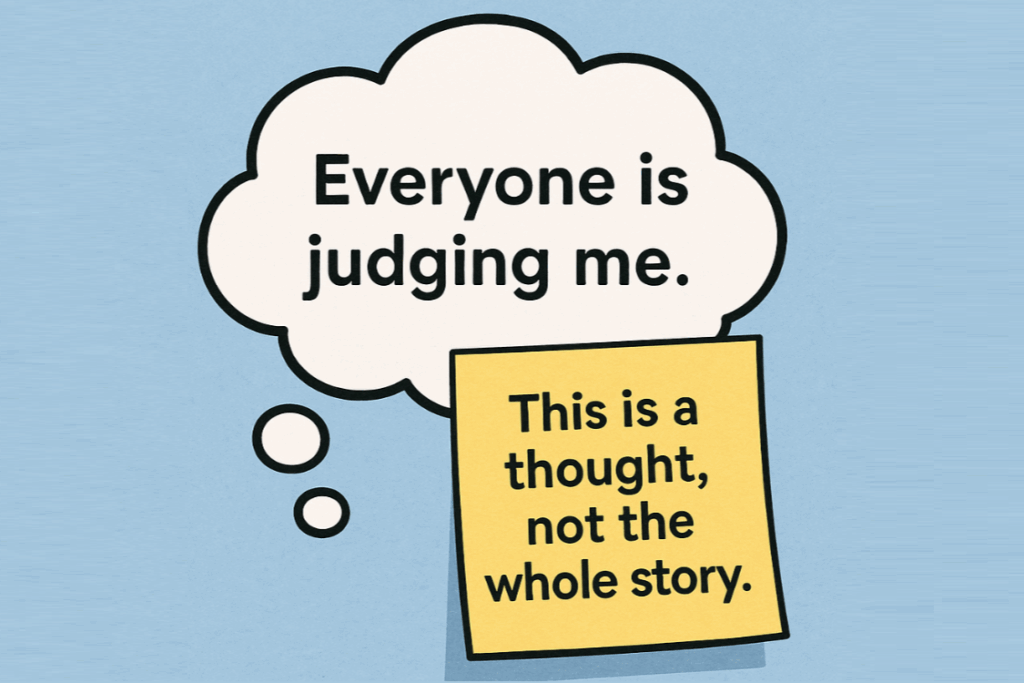
“Everyone is judging me.”
“I don’t belong here.”
“I’m going to embarrass myself.”
These thoughts don’t just float by. They arrive with urgency, as if they are reporting reality itself. And even though they are thoughts, your mind treats them like facts.
Our minds are storytellers, and they believe their own stories. Sometimes those stories are partly true, but often they get distorted. They might exaggerate, minimize, or focus too much on the negative, making threats seem bigger than they are. Social anxiety turns these distortions up to full volume, which makes the world feel more dangerous than it really is.
The way forward is to step back and see thoughts for what they are. That’s where the mental sticky note for social anxiety comes in.
The Sticky Note Metaphor
Next time a thought shows up like “Everyone is judging me,” imagine attaching a sticky note to it that says:
“This is a thought, not the whole story.”
The thought is still present, and it may still feel strong, yet now you have labeled it. You can see it as a thought rather than a fact.
And here is something important: even if there is a grain of truth in a thought, anxiety rarely tells the whole story. It exaggerates, filters, and leaves out context. Maybe someone glances at you, yet dozens of other people are focused on their own conversations. The sticky note reminds you that your anxious thought is only one story your mind is telling, not the entire picture.
With repetition, something new happens. When the same thought appears again, you may begin to notice the sticky note already attached. The reminder comes with the thought itself. That is your brain forming a new association, pairing the anxious thought with the label you have practiced. Over time, this makes it easier to recognize the thought for what it is.
Learning to Step Back
In psychology, this skill is called “defusion.” It means creating space between you and your thoughts so that you can notice them instead of being swept away by them.
- Fusion: “Everyone is judging me” → feels like reality.
- Defusion: “I am having the thought that everyone is judging me” → creates breathing room.
Imagine you’re at a party and the thought shows up: “Everyone is judging me.” In fusion, it feels completely true, and your body tightens. In defusion, you pause and say to yourself, “I am having the thought that everyone is judging me.” The thought is still there, yet you have stepped back just enough to see it as a thought instead of reality itself.
At first, you might only remember to attach the sticky note after the thought has already taken over. That still counts as progress. Each time you do it, even late, you are practicing defusion.
Why This Matters
Social anxiety trains you to buy into every anxious thought as if it must be true. Each time you attach a sticky note, you are beginning to teach your mind something new:
- Just because a thought feels true does not mean it tells the whole story.
- Just because a thought feels loud does not mean you have to follow it.
- Just because a thought shows up does not mean it defines you.
Even if you do not feel immediate relief, you are proving to yourself that your stance toward a thought can change. These small shifts accumulate and become the foundation for deeper progress.
A One-Week Practice to Try
Here is something you can experiment with over the next week:
- Pick one recurring thought that troubles you often. (For example: “I’m not good enough,” or “Everyone is judging me.”)
- Sticky note it. When it appears, add: “This is a thought, not the whole story.”
- Log it. Make a tally mark in your phone or notebook.
Think of this as a small experiment rather than homework. You are not aiming for perfection. The purpose is simply to notice what happens when you label a thought. Even one tally in a day counts as progress, because it means you noticed and labeled a thought. If you miss a day, that is normal. Each time you return to the practice, you are strengthening the habit.
Closing Thought
Recovery begins with small, repeatable shifts. Attaching a mental sticky note to a thought is simple, yet it changes your relationship with your mind.
Your mind may spin stories and urge you to believe them, but you can learn to step back. Thoughts are not always facts. One thought at a time, you can begin to see more clearly. That is how recovery starts to take root.
The sticky note is just one way to practice defusion. There are many other approaches, and I explore them in more depth in my upcoming book, A Roadmap for Social Anxiety Recovery. If you’d like to follow along as I share more tools and previews, please subscribe to my newsletter.
You can read more insights and practical strategies in my other posts.
You can read my complete story in my book.