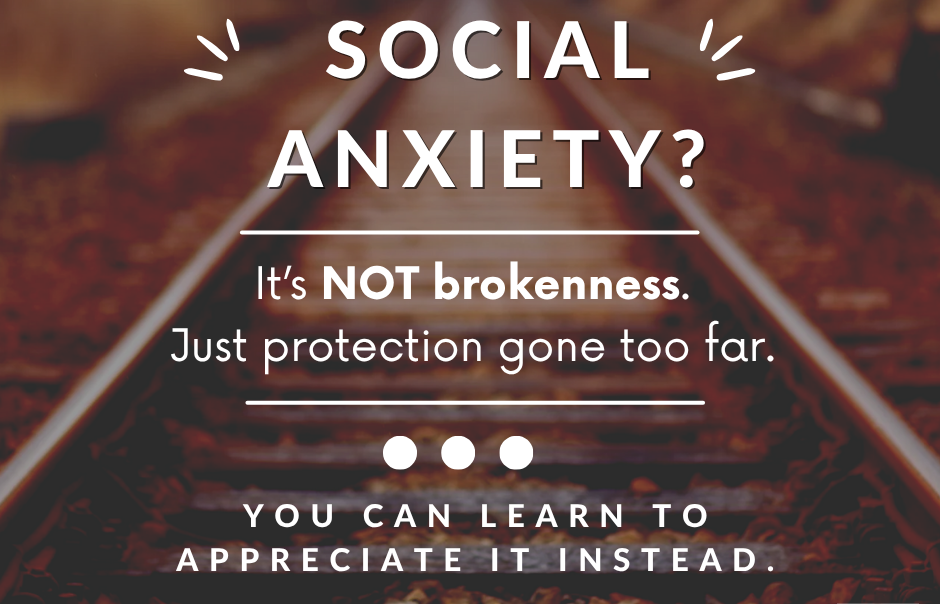
If you live with social anxiety, you probably feel like it’s the enemy. Something that’s holding you back, ruining opportunities, and making everyday situations way harder than they need to be.
How could it be that social anxiety is just trying to protect you? And the idea of thanking your social anxiety…well that just seems ridiculous.
But hear me out. What if it’s not trying to ruin your life?
What if social anxiety IS just trying to protect you?
How is social anxiety a form of self-protection?
At its core, social anxiety isn’t about being broken or weak. It’s your brain’s way of saying, “Hey, be careful.” It’s a protective mechanism, like an internal alarm system that’s just a little too sensitive.
Anxiety itself isn’t bad. In fact, it’s essential. Without some kind of internal warning system, we might find ourselves being reckless, saying inappropriate things, or putting ourselves in risky social situations. But when that system gets dialed up too high, it starts triggering false alarms.
Let’s look at how social anxiety can actually serve you.
You care. And that’s a strength
Ever met someone who talks nonstop without noticing if anyone’s listening? Or someone who’s rude, loud, or says things that make others uncomfortable?
Chances are, they’re not worrying about how they come across. And that can create real disconnect in relationships.
If you have social anxiety, it likely means you care how you affect others. You want to be respectful, kind, and appropriate. You’re tuned in. And that’s actually a really good thing – not just for you, but for the people around you. We need more people who think before they speak, who want to be thoughtful, and who care about others’ feelings.
Social anxiety just takes that sensitivity and turns the volume up a little too high.
Your internal alarm system is on high alert
Think of your social anxiety like a motion-sensor doorbell camera. If it’s set too sensitive, it’ll go off every time the wind blows or a squirrel runs past. But if it’s not sensitive enough, it might miss something truly important.
That’s what’s happening in social anxiety. Your system is doing its job – watching for possible threats – but it’s sounding the alarm for things that aren’t actually dangerous. A neutral expression from someone, a pause in conversation, a harmless comment – these might all trigger a “threat detected!” response, even when there’s no real risk.
Maybe that high alert system developed from a moment long ago. A time someone criticized you, or when you felt exposed or shamed. (The key here is felt. Maybe they didn’t actually criticize but you perceived it that way.) In any case, your nervous system remembers, even if your conscious mind doesn’t. And now it’s doing its best to make sure it never happens again.
Can’t recall such an incident? It doesn’t matter. You don’t need to go back and figure out every single incident that could have made you feel judged. Trust that you can still move forward without knowing this.
A little gratitude, a lot of change
It might feel strange at first, but try this the next time you feel social anxiety rising:
“Thank you, anxiety. I know you’re trying to keep me safe. You don’t want me to get hurt and you’re looking out for me. But I don’t need you to work so hard right now. I want to connect with people, take some risks, and show up as myself, even if it feels scary. I appreciate all you’ve done for me but I’ve got this.”
You’re not fighting your anxiety. You’re working with it. You’re letting it know: I see what you’re doing, and I’m choosing a different path now.
Try it and see what happens
I hope this has helped you see that social anxiety is just trying to protect you. It isn’t a flaw. It’s a system. One that may have protected you in the past, but doesn’t always serve you now. Understanding it a little better is the first step toward changing your relationship with it.
Try a little compassion. A little curiosity. Even a little humor.
And let me know how it goes.
You can read more insights and practical strategies in my other posts.
You can read my complete story in my book.